Why We Test Thresholds From Blood, Not Breath
There are two lab-grade ways to find your training thresholds: sample your blood lactate directly, or estimate the same breakpoints from your breathing during a gas analysis test. We use blood. Here's the physiology behind that choice, and where breath-based testing genuinely earns its place.
Both methods are legitimate. Both are used in serious labs. And most of the time, they land in roughly the same place. But "roughly the same place" is a problem the moment you're using the number to prescribe someone's exact training pace, because the two methods aren't measuring the same thing — one is measuring the event, and the other is measuring the body's downstream reaction to it.
What Each Method Is Actually Measuring
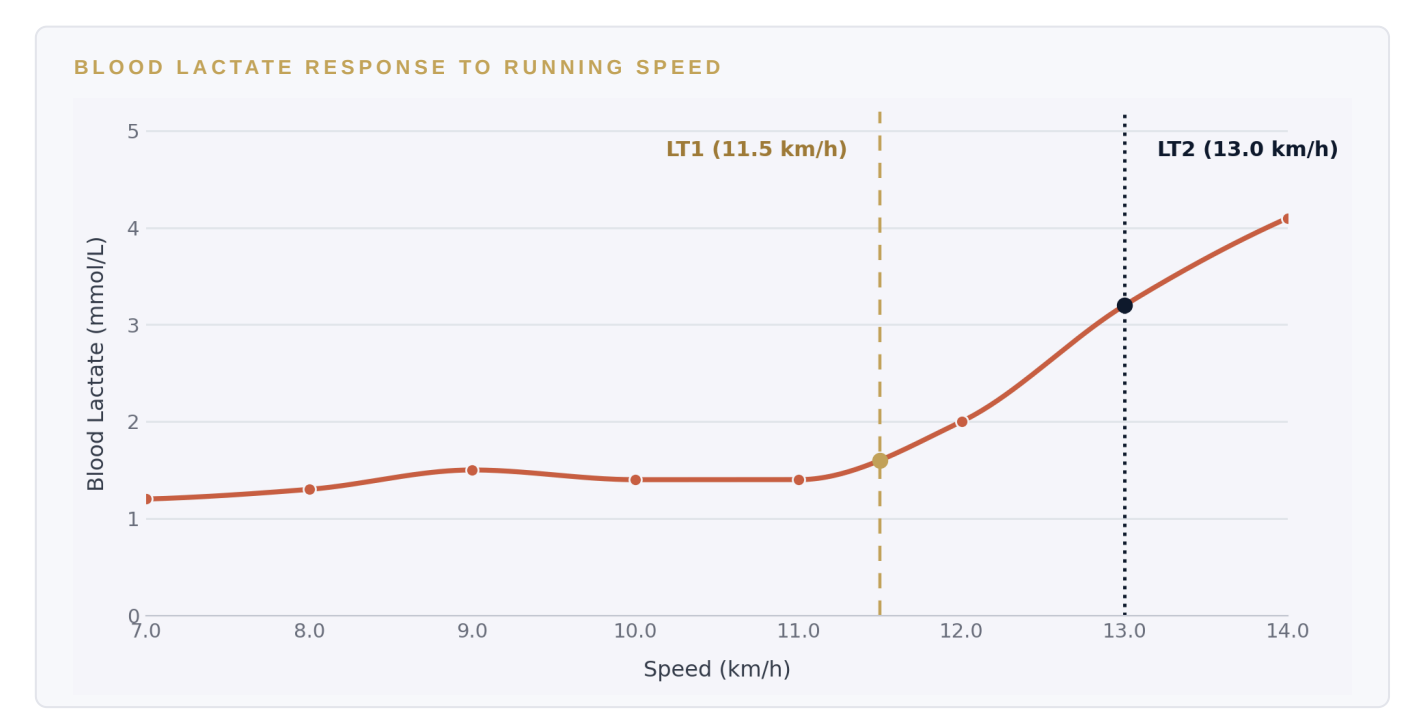
A blood lactate test takes a small blood sample, we use an earlobe or fingertip prick at the end of every stage of a graded step test, and reads the lactate concentration directly. Your thresholds are defined by where that curve changes shape: the first sustained rise above your resting baseline (LT1), and the point where lactate starts accumulating faster than your body can clear it (LT2). You're reading the metabolite itself.
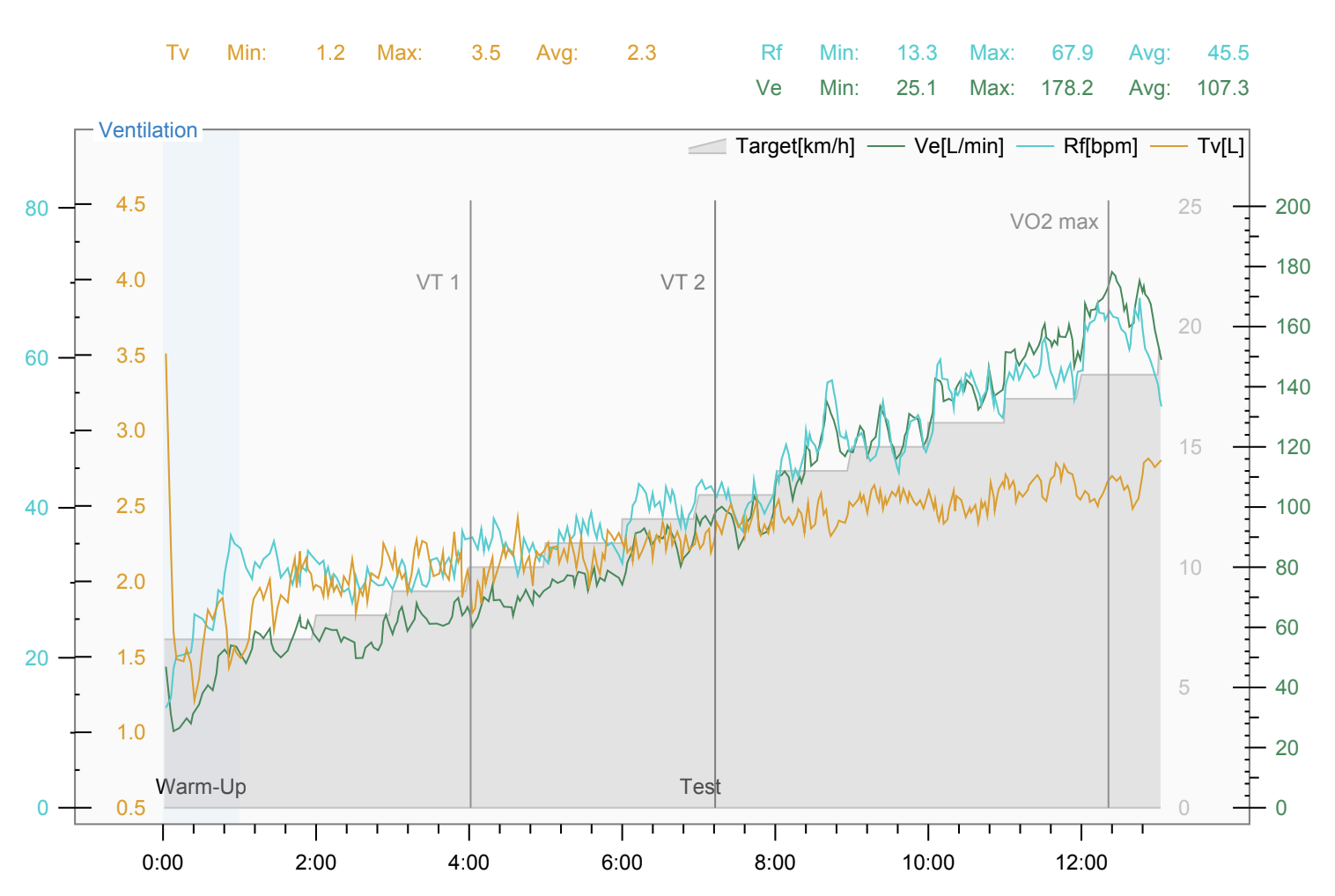
A ventilatory threshold test works differently. As lactate rises, your body buffers it with bicarbonate, which produces extra carbon dioxide, which in turn drives changes in how fast and how deep you breathe. Gas analysis tracks your oxygen uptake and CO₂ output and looks for the points where your breathing pattern breaks away from a smooth, linear relationship with effort. Those breakpoints are your ventilatory thresholds.
The distinction matters more than it sounds. Lactate is the cause. The change in your breathing is an effect, arriving after a chain of intermediate steps; lactate production, buffering, CO₂ output, then finally a shift at the mouth that someone has to identify on a curve. Every link in that chain is a place for the estimate to drift.
Where the Ventilatory Method Loses Precision
Three things chip away at how tightly a ventilatory threshold can pin down your actual physiology.
It's indirect by design. You're not reading the trigger, you're reading a downstream consequence of it, several metabolic steps removed from the muscle.
The breakpoint is a judgement call. Unlike a lactate concentration, there's no single objective figure to read off a ventilatory curve. Someone has to look at the plotted data and decide where the line bends — and different assessors, using different detection approaches, can reasonably land on slightly different points from the same underlying data.
Not everyone breathes the same way at threshold. Some people show a clean, obvious break in their ventilation curve. Others don't — their breathing shifts more gradually, with no sharp corner to point to. When the curve doesn't cooperate, the estimate gets softer still.
Blood lactate doesn't carry any of that ambiguity. The concentration is the concentration. With a controlled protocol and a proper curve fit, the threshold points are objective and repeatable — you're reading a number, not interpreting a shape.
Why Small Errors Aren't Small in Practice
A threshold estimate that's slightly off doesn't feel slightly off when you're the one running or riding at it every week. A pace or power target with real slack in it is a target you can't fully trust — and a training plan built on a number you can't trust quietly undoes the point of testing in the first place.
Push a threshold pace even a little too fast, and every session prescribed off it gets run a shade too hard, week after week. Push it too slow, and you leave adaptation on the table without knowing it. Over a training block, that compounds. Over a race, it's the difference between holding your effort to the line and blowing up with three kilometres left.
Where Gas Analysis Is the Right Tool
None of this is an argument against gas analysis as a technology — it's an argument about what each method is best used for. Gas exchange is the direct, gold-standard way to measure the things it's actually built to measure: your VO₂ max (the ceiling on your aerobic engine), your running or cycling economy (how efficiently you use oxygen at a given pace or power), and your resting metabolic rate. Blood lactate can't tell you any of those.
So the honest position isn't "blood good, breath bad." It's that each method is most accurate at measuring what it measures most directly — and we build our testing around that rather than making one tool do a job it's second-best at.
The Short Version
What you're trying to findBest methodTraining zones / thresholds (LT1, LT2)Blood lactateAerobic ceiling (VO₂ max)Gas exchangeRunning/cycling economyGas exchangeResting metabolic rateGas exchange
At the clinic, we run blood lactate testing for anyone who wants their thresholds pinned down properly, and VO₂ max testing via gas analysis for anyone who wants their ceiling and efficiency measured the same way. If you want both in one session, that's what our combined profile is for.